Photobucket

OCTOBER 2011 MIHISARA .

Exchange of experiences pertaining to the practical Alternative Programme.

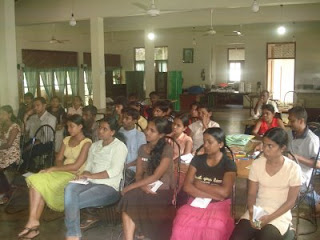
The above meeting was held on 16.06.2009 at the Savisthri National Office with the participation of approximately 75 individuals representing 10 organizations.

The proceedings commenced by listening to the song "Crown belongs to the king and the country belongs to the people" and 01 minute's silence was observed in memory of the dead and the displaced as a consequence of the war.

* A Clarification of the objective was made by Miss. Padma Pushpakanthi, National Secretary, Savisthri , Convenor of the Womens Action for Social Justice and the Mothers' Movement for Combating Malnutrition. She gave a vivid account of the :-

- Inauguration of the Womens Action for Social Justice.
- It's process.
- Problems arisen in the country as at now.
- The way of interfering in such matters.

* As has hitherto been done a glass of Cunjee made out of green leaves of nutritious value was given to the participants for breakfast.
A few lectures were delivered on the following important topics :-

- Our hereditary indigenous medicinal treatment.
- Aurvedic medicines and their favourable effects enjoyed by our ancestors.
- Tea cultivation free from poisonous stuff.
- The benefits that accrue to the environment and the economy as a consequence of tea cultivation devoid of poisonous stuff.
- The method of preparing liquid fertilizer.
- Method of preparing organic fertilizer.
- Importance of using organic fertilizer.
- How our home garden should be prepared.

- Economic benefits accruing thereof and health benefits.
- Sale of plots of land and the coconut cultivation threatened by natural disasters.

* Special mention was made of Varieties of locally grown yams.

- How they had been used as a staple food from time immemorial.
- Varieties of yams that are being used today.
- Medicinal and nutritional value of yams.
- How certain varieties of yams have become extinct.
- Should protect locally grown yams.

* Two Savisthri representatives gave an explanation regarding the Alternate Economic Programme and touched on the undermentioned factors :-

- Savings System maintained by the Savisthri Small Groups.
- Security of such savings.
- Mode of utilizing such savings for the benefit of the members without going into finance companies.

Another lecture was delivered on :-

- How the freedom of speech has been lost.
- Right to live, which is a fundamental right of all beings.
- Problems faced by individuals in their day to day life and regulations and laws enacted regarding such problems.
- Injustices in the society.
- Fear and inability to go against such injustices.
- Organization against lost rights.

* For lunch, local food items cooked and wrapped in plantain leaves were given in the customary Sri Lankan way.
* After lunch a fair was held in the premises of the Savisthri Movement by the representatives of the Six Districts where various items like Cereals, Kurakkan powdered and Packeted, cow pea, rice flour, sweet meats turned out of rice flour, various bites were displayed and sold.
* At the end of the programme the undermentioned agreements had been reached :-

- Extension of this programme within the existing social, economic and political arena.
- Constant exchange of practical experiences.

This programme which commenced at 1000 hrs. continued till 1500 hrs.

Let us weave clothes of unity.

"Savisthri" women went on a good-will mission to Baticaloa in the Eastern Province with the intention of forming a relationship with their counterparts in Baticaloa, in April 2009.

- Specialty - Being women widowed by the Cruel War "Life is not worth living. But life goes on" Those were the words uttered by these women.
- We women in the south have the responsibility of allowing those women to lead their lives. That is the feeling of our group.
- We are quite aware that we cannot solve all the problems of these Tamil Women who are alone and isolated.
- Those who govern should give a political settlement to their problem (ethnic). As ordinary citizens, in order to avoid another such group getting isolated in life, we should form a cordial relationship amongst us, understand each others feelings and must respect each and every individual.

Hence, after this goodwill mission in April 2009 let us form a very strong relationship

– Let us weave clothes of unity.
An attempt was made to find a market place for hand loom textiles woven by these 26 lone women widowed by the cruel war. By now this action of ours is being supported by many in southern Sri Lanka.

Visit to the East of Sri Lanka on a good – will mission.


23 individuals including the National Office Staff, members in the Districts of Galle, Matara, Anuradhapura, Matale and Badulla and representatives of the Womens Action for Social Justice (WASJ) participated in this journey to the East.

The objective of this visit was for the members of the Savisthri Movement in the South to form a close relationship with the women pressurized by the war situation in the North and through that to implement with them a long term alternate economic, consumer and ecological home gardening programme.

We commenced our journey on the 22nd Aprial 2009 at 1945 hrs. and spent a very difficult time without any sleep in a 3rd class compartment of the train proceeding to Batticaloa. That is a normal experience of the night passengers of the train.

The co-ordination of the PAPD institute was of immense help to us. We were able to get residential facilities at the Sarvodaya Centre.


Groups we met :-

Approximately 60 of 82 widows in 05 villages widowed by the war, the trustee of the "Jeevan Jothi" Childrens' home where the inmates were children orphaned by the cruel war and 82 such children.

The chief incumbent of the Mangalarama Buddhist temple who was leading a very religious life and living with the Tamil Community.


Widowed women, an individual who got involved in the handloom industry and who lost the market due to the war and who was enthusiastic about the reasonable trade.


A document giving an analysis of it's social, economic and political background is being formulated.

Long term practical programme

The "Savisthri" members in the South who participated in this programme had taken along with them various kinds of seeds (Sorghum, Cow – Pea, Vegetables) collected from their own home gardens and planted in the home – gardens of their relatives in Batticaloa.
o On our visit we accompanied a resource person with practical and theoretical experiences in home gardening who had the ability of explaining in the Tamil language about the timely requirements and the importance of ecological home gardening.


We had the ability of preparing 05 home gardens in the premises of the members of the groups whom we met, with the assistance and participation of all.

Suggestions put forward to bridge the gap between those in the South and the East:-

Women in the South should organize such a meeting in the future and to preserve a portion of the monies expended for Mini Society Congresses to meet the expenditure of such a meeting.

To continue the relationship through correspondence.

To organize a meeting between the widows in Batticaloa widowed by the cruel war with their counterparts in the south.

Agreement reached to prepare their own houses for food and lodging in the event of such an encounter in the future.

For the women in the South to interfere and provide a market for their counterparts in Batticaloa to sell their textiles as a measure of giving a helping hand to them.

Training workshop on Digital Photography

The above training course was held on 01.05.2009 by the Savisthri Movement with the sole aim of giving an awareness regarding the submission of a report in a correct manner, at the C.R.C. Institute, Thalahena, Malabe with the participation of 10 Savisthri activists.
Two individuals viz Prasanna Rathnayake and Chamara Balasooriya acted as Resource Persons. At this workshop a theoretical and a practical knowledge was imparted as to how a photograph should be taken that could be read accurately and correctly.

At the outset Mr. Prasanna Rathnayake and explained the importance of photography for an institute like the Savisthri National Movement. He pointed out that in certain instances where futile attempts are made to explain certain things using a barrage of words, a vivid explanation could be given by a single photo. With the assistance of Mr. Chamara Balasooriya, Mr. Prasanna Rathnayake identified the several parts of a camera and the functions of each such part and how they are used in photography.

Subsequently he explained the various ways of taking individual photographs / group photographs and sceneries and provided an opportunity for the participants to take such photographs and explained the short-comings in the photographs taken.

Mr. Prasanna Rathnayake gave an awareness regarding photographs taken using a Vedeo camera and a Digital camera. He gave a vivid explanation how such photographs should be computerized and conserved and how reports are submitted utilizing such conserved photographs.

Finally a report was prepared utilizing the photographs taken at this programme.

The knowledge thus gained could be utilized when submitting reports pertaining to programmes at District Level as well as National Level.

Break the Silence in search of Life


Whole society unconsciously lay on lifeless shadows like stone image without thought, no any lamentation when body cry for its feelings covered with blanket of grief, tears dried on checks and murmuring to air that penetrate in to the bones skins and flesh.

When laugh dried on lips?
Who has stolen our future?
How long we bear up the silence?

You and I spend the time of tragedy in our life, every faces have line of pains which illuminate joy of life, dead always embraces us with its crude hands, we have silent for the death of others but now we have to silence for our dead. Our conscience asks touch our skins bones and flesh, when you awaken your life? When you raise your voice breaking the silence, when you step up in search of life?

Woman is not symbol of dead. Woman is symbol of life in history of human evolution. Woman is symbol of love and beauty. World is created by heat of the Sun and mother’s love. (Maxim Gorky) Woman is a spring never dried, bearing all creations not only love beauty and warm. Woman is life and existence, power of the regenerate of human society.

But we are living in a very deferent world, the world is really globalize, a world dominated by the ideology, the principles of neo liberal globalization. It’s identified all creatures and resources as commercialized goods on free market. All myths of free market choice hang on the organs of woman. There is no any existence to capitalists’ trade and advertising without nudity of the woman.

Over 900 million people undernourished and 800 of them live in the third world like the countries in Sri Lanka, its estimated that 600 million people living in the south today will not live to see their 40th birthday. One out of every five children suffer from growth retardation and one out of every three is underweight; 30,000 who could be saved are dying every day, 2 million girls are forced in to prostitution. 130 million children do not have access to primary education and 250 million minors under age bound to work for a living.

Every year 146,000 girls are pregnant in case of sexual harassment 25% of them are dying at the moment of child delivering. 0nother 2 million Muslim girls are forced to FGM reported complains in Bangladesh 90% is rape cases, 32% of them are child girls. Most abductions in Indian soil is reported child girls from 6 to 18 years and national commission for women’s says 30 – 50% of them sole out to brothel house for prostitution.

This is the reality of globalize world, we unable to erase the present conditions of women in Sri Lanka in continues war. Half of her population defends on 200 rupees per day, most of them are poor who throw out from the social structure as human waste and they are chronicle suffer from lack of foods and malnutrition. 32% of children undernourished one out of three in the line of underweight; 45%of pregnant mothers are suffering from anemia, in case of that condition picked up the flowers of future generation. The child girls of rural and slums of suburb areas are made pregnant in deep dark dried up springs of motherhood, Young woman are naked as a prostitute in consumerism to enjoy for male heat.

Clash of civilization?

Woman is a victim of violation fired by the power politics of male domination, she keep at the line of limitation in discrimination of war economic and cultural bound, but she is the main tool of financial production, more than 12 hundred thousand male and female working forces sent to overseas to make foreign exchange as slave by free market machinery in last three decades, 65% of them are female, earn USD 2000 millions per year. 6 hundred thousand work forces in plantation area, half of them are women; they earn USD 1 billion, 280,000 working youths in free trade zone, 75% of them are girls produce two billion US dollars, but this money would not be freed from the slavery and succeeds social life of women.

Few months ago our foreign exchange is 3.4 USD billions, but today 1.2 billion. Who destroy the economic of women’s produced by through blood, tears and swells. Working women of plantation area sat on doorway with her children on starvation, and ask who stolen our future? More than 16,000 working girls throw out in dustbin as unemployment, ask tomorrow for youth? More than 10,000 widows of dead solders of south last three years take unfertile harvest through brutal war. Hundred thousand women who displaced from Tsunami and ethnic conflict are waiting for justice.

Widows of south and north!!
Women of unemployment!!
Mothers are waiting for their children who never come back from war
How long we waiting for ……..
Dear Sister breaks the silence in search of love

Womens Day held on 08. 03. 2009 by the Savisthri Movement

" Break the silence in search of Life"


On 08. 03. 2009 at 0700 hrs. the representatives of the network organization "Womens' Action for Social Justice." (WASJ) met opposite the Fort Railway Station, Sri Lanka to commemorate the International Womens' Day. The members of the WASJ distributed a pamphlet on the theme " Let us break the silence and continue our life." They were able to distribute approximately 1200 pamphlets in 90 minutes.


Sharp at 0845 hrs. a group of about 30 WASJ members boarded the Baticaloa (Eastern Province) bound train and together with the cultural group they visited most of the compartmants of the train singing songs depicting the violence against women and the value of the womens contribution for social, economic activities in the country and the pressure exerted on the poorest women in the farming, fishing and plantations labour sectors and distributed a hand bill to create an awareness amongst the train commuters about the prevalent position.


All the train commuters belonging to the ethnicities Sinhala, Tamil and Muslim were seen reading the hand bill 50 distributed. Hand bills were distributed amongst the people at the railway stations too and they seemed to by attracted to the contents of the hand bill.

Reactions of the community

· The train commuters expressed the view that such awareness was very important and if that awareness was given by a female more attention could have been drawn from the people.

The crowd was from various areas and they had been induced to collect hand-bills for distribution amongst the people in their areas.

- 5000 copies of this pamphlet had been printed in both Sinhala and Tamil.
- This pamphlet was distributed amongst the people at the womens' programme conducted by NAFSO organization in Kalmunnai.

Contents in the document

Particulars pertaining to the way pressures are exerted on women in the garment treade, house-maids who serve in foreign countries, plantation labour, cottage industries, by the globalized economic process.

- War
- escalation of the cost of living
- Getting subjected to anaemia and weak health
- Age – old customary concepts
- Fall in rural livelihoods farming, fishing and small production sectors.
- Indebtedness in rural areas.

Future Process

Plans have been made by the Savisthri Movement to hold discussions at rural level based on the contents of this document.

The participants returned to the Fort Railway Station at 1600 hrs. from Kurunagala after carrying out activities pertaining to the Womens' Day in a fruitful manner.

International Womens Day which falls on 08. 03. 2009 - SAVISTHRI

Plans have been made by the Savisthri Movement together with the network organization "Womens Action for Social Justice" to implement a special programmes on the Womens Day which falls on 08. 03. 2009.

In view of the fact that the Women have been severely pressurized by the existing social, economic and political situation prevailing in the country, the objective of this programme is to draw the attention of those responsible to this issue and give an awareness to the masses to look at this process in an intelligent manner.

We analyse the pressures placed on women due to the following factors:-

Economic Process

· Inability to get a market for their produce.
· Women being relegated to the position of providing cheap labour in the garment, planatation labour sectors and as migrant workers.
· Deprivation of their independence by making them indebted through various banking systems and financial processes.
· Getting unemployed and joining the rank of the poorest of the poor due to the closure of garment factories in the face of the existing financial crisis.
· Inability to return to the village and commence work and stabilize themselves to eke out a living.

Social Process

· Severity of the mental pressures and agonies.
· Inability to get recognition in the society due to the existing social tendencies regarding women.
· Getting widowed in great numbers.
· Being cornered in the society due to lack of economic strength.
· Increase in the incidence of getting subjected to nutrition problems, anaemia and various other diseases.

Political Process

· In the decision taking process, less representation of women in parliament and other local bodies.
· As a consequence, the decisions reached do not favour women.
· Use of violence, harassment and thuggery against women.
· Blocking the avenues available for women to participate in decision making in the womens leadership that is being formed, by the use of wealth and thuggery.
· Policies of political parties not being firm and limitation of such policies only to paper.
· All women belonging to the ethnicities Sinhala, Tamil and Muslims in the country being subjected to mental pressures and physical harassments due to the war situation prevailing in the country.
· Tens of thousands of mothers suffering eternally at the loss of their precious children and children made disabled by the cruel war.

The naked truth is that a majority of women are pressurized in the face of these countless problems. It is also clear that no solution could be found to these problems by refraining from voicing their grievances.

It is only through awareness and getting organized as a body that attention could be drawn to the responsible authorities and seek solutions to these countless issues.

Today the responsibility of working for social justice is vested with the mothers, the women, who constitute 53% of the country's population. The time is ripe for women who count more than half the population in the country to stand together for the establishment of the right for all the people to live peacefully devoid of any differences, disrespect and harassment.

The network organization "Women's Action for Social Justice" (WASJ) has made arrangements to distribute a hand – bill which gives an awareness on the Womens Day ie on 08.03.2009. Hence, you who speak and always think of making better the situation prevailing in the country could participate in this programme.

Date - 08. 03. 2009

Commencement

· At 0700 hrs. opposite the Fort Railway Station.
· At 0845 hrs. to board the train leaving for Vauniya and get off at Kurunegala.
· Distribution of hand-bills in the Kurunegala Town (Family Relief Service Centre is scheduled to take action re. this matter).
· Plans made to have recitals (Virudhu / street dramas to create an awareness amongst the people).

· 1530 hrs - End.

Monthly progress and activities of the Savisthri Movement

Consumer Service of the Savisthri Alternate Producers and Consumer Section.
Food devoid of poisonous stuff for a healthy life.


A marketing stall was inaugurated in the Savisthri National Office on 07.01.2009 for the purpose of providing food of nutritional value collected from the Six Districts where Savisthri programmes are being implemented. To mark the occasion a small function was held on the day in question with the participation of Savisthri members and neighbours. This stall is being kept opened on the five week days commencing from 9000 hrs. to 1700 hrs. and cater to the needs of the Savisthri members and neighbours.

The Savisthri Home Gardening programme is successfully carried out in the Matara District and it is worth, mentioning that a Mini Bank Society member named "Nirosha" has been able to collect a good harvest from he. garden where she had cultivated various items including a variety of yams. Some neighbours who were thrilled at her success and after getting aware that Nirosha had received all the assistance from the Savisthri Movement had formed a small group consisting of six members.

A school Nutritional Programme.

Subsequent to the Savisthri Food programme carried out in the Six Districts including Galle District coinciding with the world food day, a special programme had been carried out in the Ratgama Sirisumana college to provide cunjee which is a nutritious food to the school children prepared out of various herbal plants grown in the home gardens of the villagers. This programme is being carried out with the assistance of the Galle District Savisthri Co-ordinator, Savistheri Women leaders and the parents of the school children.

A policy for economic activities

A draft document regarding an alternate economic policy to be submitted to the government is being discussed amongst the members of the Savisthri Movement.

Women's Policy Document

Copies of the draft of the Women Policy document formulated by the Savisthri Movement has been made available to the District Organizations in the Matara District and it is being expected to discuss this matter in the month of February.

Survey conducted to collect information regarding the lost land rights.

A survey is being carried out through the Womens Action for Social Justice (WASJ) regarding the injustices meted out to women as a consequence of their losing land rights.

The Second survey is to be carried out by the Savisthri Movement regarding the various irregularities that have resulted as a consequence of the re-location of the tsunami victims.

A view expressed by a member

L.G.Nimanthie Wijayanthi of the Mini Bank Society Gandhara, Matara says that she has been able to strengthen her economy through the awareness gained by her with her participation in the various programmes implemented by the Savisthri Movement. She is full of praise for Savisthri for getting an awareness regarding the preparation of a nutritious meal and being able to prepare a good home garden.

Human Rights Protection Committees

With the special knowledge gained regarding Human Rights, a special programme was organized in the Moneragala District by the Human Rights Committee regarding health rights. For this awareness programme, 52 people participated including the Savisthri National Secretary and representatives of some other organization. As a consequence of this programme, a decision was taken to impart this knowledge to the rural community, to collect particulars regarding health policy violations at each monthly meeting and to have a special discussion to get views and suggestions for the alternate economic policy and the women's policy document.

Youth Camp at Matale

A three day awareness programmes was held on January 23, 24 and 25. 2009 in the Matale Raja Maha Viharaya (Buddhist Temple) to create an awareness amongst the youth both males and females in the Matale District on the theme "comple man, full society" with the co-ordination of the Savisthri National Office.

At this, a workshop was held on the personality of the youth, social obligations, art, youth and global warming. Savishtir expects to extend this workshop to other Districts as well.

District programmes held in the month of January 2009 :-

Several District programmes like holding SAPCA committee meetings, awareness given to Human Rights Committees, exchange of the products, holding youth camps etc. had been held in the Six Districts in the month of January 2009.

What is this present social crisis?

A discussion regarding the existing social crisis as felt by each individual was held in the Savisthri National Office at 1700 hrs. on 28.01.2009 with the participation of representatives of various organizations, independent individuals as well as members of the Savisthri Movement.

Activities of the Savisthri Movement during the month of December 2008

Guidance given by Savisthri for the Development of Women

On 30th December 2008, a workshop was held in the community Development Centre in Malabe situated in close proximity to Colombo on the subject, " Duty of women for Social Development" organized by the Sustainable Agricultural and Research Development Institute which works in affiliation with the women – folk in 10 Districts. The Savisthri Movement which is engaged in that activity participated at this workshop and contributed it's share by providing resource personnel, made a clarification regarding the importance and the necessity of collective work, analysed the social, economic and political conditions and making a clarification regarding Savisthri activities in those fields. It is scheduled to hold this meeting in future at rural level.

Staff Training

A two day residential workshop was held at Sarvodaya Development Centre at Bandaragama on 2008.12.06,07 for the development of the skills of the Savisthri staff. This programme commenced on the 5th evening and awareness was given regarding the Savisthri vision, Alternate Economic Development activity, formation of Human relations, Human Rights Protection activity, Home Gardening Programme, decision taking, formation of small groups and communication process. A special feature of this programme was the functioning of Savisthri activists as Resource Persons . The Savisthri News Bulletine wishes that Savisthri would commence a successful journey in the year 2009.

National Workshop on Human Rights

A three day workshop on Human Rights was held in the Savisthri National Office on 2008.12.22, 23 and 24 with the participation of 27 members from the 06 Districts where Savisthri programmes are being implemented chaired by the Advocate S.G. Punchihewa. One Mr. Sivagurunathan acted as the Interpreter.

Awareness was given regarding the identification of human rights, how they are being violated, what action should be taken in such instances and children's rights. Through group exercises, awareness was given by the provision of leaflets. In addition, awareness was given regarding our rights in relation to the activities vested with the provincial councils and in relation to consumer affairs.

As mentioned above this workshop was held in the Savisthri National Office and all the participants gave their unstinted support in the cleaning of the premises, aiding in the provision of refreshments, organizational work etc. to facilitate the smooth working of the workshop. In the post activities of this programme gather experiences, were exchanged amongst the members of one Mr. Saranapala, the veteran Trade Union Leader and through the display of a film by Robeto Bethnigi woven round a Jewish family concentrated in a Nazi camp during the 2nd World war. The Savisthri News bulletine expects that the knowledge thus gained would be utilized in the Human Rights programmes that would be held in the course of this month.

Mini Bank Society Anniversary

Two anniversary celebrations of the Mini Bank Societies at Gandara, Matara and Helawatta were held on 2008.12.19 and 21 at which leaders of the Mini Bank Societies participated and expressed their views, appointed new office bearers, initial discussions taken place regarding the formation of Human Rights Committees and as a special item, work plans for the year 2009 embodying targets too had been submitted. At each anniversary of Mini Bank Societies in the Matara District, fairs had been held and new fairs are being held at Mini Bank Society Level. Each member has a home-garden and the produce of such home gardens are brought and sold at the weekly fairs.

District Programmes - Anuradhapura

The anniversary of the Mini Bank Society at Eppawala, Anuradhapura District was held on 14th December 2008. This is the second anniversary of this Mini Bank Society and dividends at the rate of Rs. 1250/- had been given to each of the members.

Throughout the month of December, Shramadana Programmes had been conducted in the ecological Farm every week on Saturdays with the participation of children and Savisthri members. A Shramadana was held on 2009.01.02, 03 and 04 and all relevant documents would be handed over to the new Divisional Secretary pertaining to the vesting of the right to the farm land with the Savisthri Movement.

The food exhibition of the Savisthri Movement in it's food programme that was implemented to coincide with the World Food Day - 16th October 2008.

The Savisthri Movement Launched a food exhibition in eight (08). Districts of Sri Lanka viz Galle, Matara, Moneragala, Matale, Anuradhapura, NuwaraEliya, Kegalle and Kurunagala in the months of October and November 2008 to coincide with the World Food Day.

Kegalle District on 10th October 2008.

This programme was organized by the members of the co-operative women's organization which is a member organization of the Womens Action for Social Justice (WASJ). Approximately sixty people participated at the exhibition and children from 3 schools . At the exhibition more priority was given to make the people aware of the usage of various kinds of yams to solve the prevailing food crisis.

Anuradhapura District on 17th October 2008.

This was organized by the Savisthri District Collective, Anuradhapura. Approximately 350 persons participated. The field co-ordinator of Anuradhapura District, a doctor of indigenous medicine made a reference to the existing global food crisis and encouraged people to grow their own food in their gardens free of chemicals and consume nourishing food avoiding any poisonous stuff. A drama was staged with the participation of Savisthri community members highlighting the value of home grown food. There were nearly 200 different varieties of vegetables. fruits and medicinal plants.

Matale District on 2008.10.22, 23

Approximately 100 participated including school children, invitees, local government officers, Grama Niladharis and members of the Savisthri National Movement. There was an exhibition and sale of palatable cooked food. An awareness was given to those assembled that the produce viz vegetables, fruits, cereals and yams were all nutritious and free from any chemicals as only organic fertilizer had been used for their cultivation. Two members from the Pradeshiya Sabha (local government institution) and the Grama Niladhari of the area were so taken up with the food exhibition they expressed their satisfaction regarding the work that is being implemented in the area by the Savisthri Movement.

Galle District - 2008.10.26.
Approximately 350-400 participated including Savisthri members in the Galle District, youth, school children and the fishing community. There were cereals, green leaves various dishes turned out of fish (Ambul Thiyal, Jaadi etc), traditional sweet – meat prepared from locally grown rice, various kinds of cunjee prepared from a variety of herbs, a variety of yams both cooked and uncooked, indigenous medicinal plants were all kept on display, which attracted the participants.

Lecturer were given to apprise the people of the prevailing food crises, dangers of consuming food items grown utilizing chemicals and weedicides, health problems, environmental changes and reasons for such changes and how they should be avoided which were highly appreciated by the people.

Moneragala District

This food programme was held in the Moneragla District on 2008.10.30. Amongst the participants were Savisthri members in the area, those well versed in food production, members of government and non-governmental organizations and ordinary people.

A variety of cereals and food items grown in chenas, various drinks made out of herbs, cow's milk, packeted seeds collected from plants grown utilizing organic manure and plants including herbs were kept on display.

In addition to food items which were of nutritious value and grown in their home-gardens, there were handicraft too such as bags and boxes made out of reed.

There were four food stalls where various kinds of cooked rice and delicious curries made out of home grown vegetables, yams, Jaadi and mush-rooms were kept on display, cunjee made out of different kinds of herbs and palatable dishes made out of cereals and fruit and vegetable plants too were kept for sale which were sold at very cheap rates.

Matara District

This food exhibition was held at the Dondra esplanade Matara District on 03.11.2008 .

Approximately 1000 people, members of the youth groups, invitees and several others participated.

This programme included an alternate food exhibition, a display of plants both vegetables and fruits grown in the home gardens utilizing organic manure, various kinds of yams, a variety of cunjee made out of green leaves and cereals. Awareness programmes regarding global warming, special awareness programmes conducted by resource persons, and there was a brisk sale of local food cooked and uncooked and various palatable dishes were on display.

There were altogether five (05) stalls. These stalls displayed local food used by the Sinhala Buddhists, Muslims and Hindu communities to celebrate their cultural festivals. There were various traditional sweet-meats prepared out of home grown cereals like rice, millet and these constituted of oil cakes, kokis etc. which are normally prepared for the Sinhala New Year. Likwise traditional dishes had been turned out of locally grown cereals which are normally seen on the festive occasions of the Hindus and Muslims.

There were several decoctions made out of fruits like avocado, melon and cunjee turned out of various kinds of herbs which are freely available in the home gardens.

In addition those participated were given an awareness regarding the preparation and nutritious value of such foods and cunjee.

An awareness had been given regarding rice, our staple food and the preparation of various kinds of dishes turned out of rice viz Milk rice, coconut rice, green gram rice and their nutritious value. Added to all these, there were sweet potatoes etc which had been displayed raw as well as cooked, fish, Jaadi (preserved fish) and Maldive fish all turned of out of Tuna Fish for display and sale.

In a separate stall, there were posters depicting the global warmth, which gave an awareness regarding the climate change and it's repercussions.

The successes of this programme include.

- The reduction in the usage of polythene by 90%.
- Availability of food in abundance.
- Several awareness programmes conducted
- Contribution made by the women to make the programme a success.

As for the failures less participation inspite of the fact that it is a heavily populated area. Dumping of several products and items in a small space and less attention paid to educational posters could be cited.

It became very clear of the importance of holding such exhibitions in those areas.

Kurunegala District

The food exhibition organized by the Savisthri Movement was held in Kurunegala on 11.11.2008 in the Vahara village in the Kurunegala District. There were 65 participants in all including 50 members from the villages, 01 priest , school teachers, a doctor of Indegeneious Medicine and members of the Rural Development Society. One teacher who was present extolled the importance of holding such exhibitions and assured that in future he would liaise the school with such activities.

There was an exhibition of posters prepared by the Savisthri Movement depicting the ill effects of consuming fruits, vegetables and cereals grown utilizing chemicals and the benefits by using food items grown utilizing organic fertilizer. An awareness was given regarding the nutritious value of home grown food items freely available in the home garden.

NuwaraEliya District

The food exhibition was held at the school premises Queensbury Estate, NuwaraEliya District on 12.11.2008 from 1000 hrs – 1330 hrs.
Approximately 300 individuals participated including the Principal, Queensbury estate school, school children, Estate Superintendent and employees in the estate.

The food exhibition commenced with a drama staged by the school children. The aim of the food exhibition "We could prepare a nutritions meal without any poisonous stuff" was explained to those assembled.

There were various kinds of fruits, vegetables and yams on display which were grown by utilizing only organic fertilizer. Boilled Manioc and other yams were kept on display which had a brisk sale. Since the villagers used to purchase food and their daily needs by paying exorbitant sums of money a request was made for them to grow yams in their gardens using organic fertilizer to enable them to have a wholesome meal devoid of any poisons.

On the whole this was a success. Although not hundred percent successful the participants highly appreciated the efforts made by the Savisthri National Enterprise to create an awareness amongst the people of the value of consuming home grown food utilizing organic fertilizer which is of a highly nutritious value. Even the principals of schools highly commended the effort and assured that they would liaise school children in our future programmes. The various requests made by school principals, temple priests and villagers to hold this exhibition in their premises vouch for the success of this programme. Furthermore:-

· The principals of several schools have prohibited the sale of cooked items made out of imported flour in the school kiosks and have requested the children to bring cooked meals from home and to refrain –from using polithene and plastic bottles, which result in environmental pollution.
· Principals have initiated action to have home gardens in their school premises.

· Parents of school children have requested assistance from the Savisthri Movement for the commencement of home gardens.

· Schools have initiated action to provide a cup of cunjee made out of herbs to each child twice a week.

· State institutions like the Police have called for a discussion regarding food devoid of poisonous stuff.

· Discussions held to show this exhibition in other Districts as well.

· At the exhibition held, the trade stalls where alternate produce were displayed and sold had a high attraction and requests made to have such stalls in their areas as well.

· In most of the Districts action has already been taken to inaugurate weekly Sathipolas (trade outlets) to sell vegetables, fruits, green leaves, cereals grown utilizing organic fertilizer.

· At the end of each exhibition in the eight Districts action had been taken to collect signatures of the participants to the public petition organized in co-ordination with the public activity for the settlement of the food crisis, thereby collecting approximately 4000 signatures to the petition.

A Healthy Life for All Living Beings-A special Programme based on the World Food day which falls on 16.10.2008

The food crisis which is being experienced by the whole world is being felt in Sri Lanka as well. The escalation of the food prices has become a heavy burden to the masses. The people have got accustomed to purchase food at exorbitant prices and there is no guarantee about the nutritious value of such food. The number of patients increase day by day and various disasters that occur due to environmental changes too are on the increase and it is clear as crystal that there is a close liaison between these factors.

The first class food producing companies which have invaded the market are manouvering and using various methods to expand their products with the main aim of deriving a profit. Nutrition, health and other environmental factors are not their concern in their search for wealth. The ill effects are experienced by the poor majority.

Our experience is that a majority of the population in our country are affilicted with one or two of the undermentioned diseases.

Kidney ailments Various aches and pains.
Diabetese Catarrh.
Heart troubles. Poor vision.
High pressure. Greying of hair at a young age.
Leaukemia. Tooth decay.
Severe epidemics . Indolence.
Leptospirosis/ Dengu/ Malaria.

The power of resistence in our bodies to these diseases have now vanished. Due to the lack of resistence power people are prone to fall prey to various diseases. From time immemorial people have toiled hard in the paddy fields for their livelihoods and they got accustomed to associate their lives in canals and muddy fields and rivers. The revelations made now that maddy water in specially paddy fields contain poisonous stuff that would harm the cultivators bring a shudder to their bodies.

The agriculture and plantation work thrust on the farmer today using imported fertilizer and other chemicals and insecticides had become the order of the day. Chemicals are added to vegetables, fruits and cereals to keep cereals longer. Chemicals like Malathion and Actalic are added to cereals. Instant food added with preservatives and essences are available in abundance in the market. It has been revealed that the additives used for food are chemicals that are used in cleaning iron, alluminium sheets and lavatories. It is no secret that genes of scorpions, spiders are used in the preparation of genetically modified food which has resulted in several deaths.

When considering these factors it is not reasonable to place the blame for various diseases on rats and mosquitoes alone.

Hence people who live and consume :-

In an environment polluted by poisonous staff.
Who consume food contaminated by poison.
Who consume food devoid of nutrition.
Who become prey to the poisonous food available in the market.
Whose bodies absorb poision through indulgence in the five senses have to live a life of uncentaimity with death at a short distance.

What should be done

The agriculture that is being forcibly done utilizing poison and chemicals to the good earth should be stopped immediately.
We should engage in agriculture which has the ability to naturally improve it's quality.
One should produce one's own food taking into consideration nutrition and health of all beings.
Get accustomed to consume customary food that is available free and which are inherent in abundance in the relevant areas.
Adherence to food patterns paying attention to nutrition and health and not according to the requirements of the market.

Taking into consideration all these factors and as a group which has acquired vast experiences by making these factors practical, the Savisthri organization and the Womens Action for Social Justice (WASJ) have formulated a plan to make the people adhere to the customary nutritious food free from poison and chemicals and with this end in view have initiated action to inaugurate and maintain food marketing stalls with nutritious food, awareness programmes and exhibitions in 12 Districts in the month of October 2008 based on the World Food Day.

Particulars pertaining to this activity are given below:-

Aim

To make the masses get accustomed to the use of nutritious food which is freely available, devoid of poisonous stuff.

Theme
A healthy life for all beings.

Venue
Selected places in the 12 Districts.

Contents
Display of posters, forms, marketing stalls with nutrition food devoid of poison and chemicals.

Expected aim
Get accustomed to local / inherent in the relevant areas / food which is freely available.

To do away with contaminated food.

Awareness

Through Resource Persons, activists, members, creative work prepared in an attractive manner and through street dramas.

A Healthy Life for All Living Beings-

The food crisis which is being experienced by the whole world is being felt in Sri Lanka as well. The escalation of the food prices has become a heavy burden to the masses. The people have got accustomed to purchase food at exorbitant prices and there is no guarantee about the nutritious value of such food. The number of patients increase day by day and various disasters that occur due to environmental changes too are on the increase and it is clear as crystal that there is a close liaison between these factors.

The first class food producing companies which have invaded the market are manouvering and using various methods to expand their products with the main aim of deriving a profit. Nutrition, health and other environmental factors are not their concern in their search for wealth. The ill effects are experienced by the poor majority.

Our experience is that a majority of the population in our country are affilicted with one or two of the undermentioned diseases.

Kidney ailments Various aches and pains.
Diabetese Catarrh.
Heart troubles. Poor vision.
High pressure. Greying of hair at a young age.
Leaukemia. Tooth decay.
Severe epidemics . Indolence.
Leptospirosis/ Dengu/ Malaria.

The power of resistence in our bodies to these diseases have now vanished. Due to the lack of resistence power people are prone to fall prey to various diseases. From time immemorial people have toiled hard in the paddy fields for their livelihoods and they got accustomed to associate their lives in canals and muddy fields and rivers. The revelations made now that maddy water in specially paddy fields contain poisonous stuff that would harm the cultivators bring a shudder to their bodies.

The agriculture and plantation work thrust on the farmer today using imported fertilizer and other chemicals and insecticides had become the order of the day. Chemicals are added to vegetables, fruits and cereals to keep cereals longer. Chemicals like Malathion and Actalic are added to cereals. Instant food added with preservatives and essences are available in abundance in the market. It has been revealed that the additives used for food are chemicals that are used in cleaning iron, alluminium sheets and lavatories. It is no secret that genes of scorpions, spiders are used in the preparation of genetically modified food which has resulted in several deaths.

When considering these factors it is not reasonable to place the blame for various diseases on rats and mosquitoes alone.

Hence people who live and consume :-

In an environment polluted by poisonous staff.
Who consume food contaminated by poison.
Who consume food devoid of nutrition.
Who become prey to the poisonous food available in the market.
Whose bodies absorb poision through indulgence in the five senses have to live a life of uncentaimity with death at a short distance.

What should be done

The agriculture that is being forcibly done utilizing poison and chemicals to the good earth should be stopped immediately.
We should engage in agriculture which has the ability to naturally improve it's quality.
One should produce one's own food taking into consideration nutrition and health of all beings.
Get accustomed to consume customary food that is available free and which are inherent in abundance in the relevant areas.
Adherence to food patterns paying attention to nutrition and health and not according to the requirements of the market.

Taking into consideration all these factors and as a group which has acquired vast experiences by making these factors practical, the Savisthri organization and the Womens Action for Social Justice (WASJ) have formulated a plan to make the people adhere to the customary nutritious food free from poison and chemicals and with this end in view have initiated action to inaugurate and maintain food marketing stalls with nutritious food, awareness programmes and exhibitions in 12 Districts in the month of October 2008 based on the World Food Day.

Particulars pertaining to this activity are given below:-

Aim

To make the masses get accustomed to the use of nutritious food which is freely available, devoid of poisonous stuff.

Theme
A healthy life for all beings.

Venue
Selected places in the 12 Districts.

Contents
Display of posters, forms, marketing stalls with nutrition food devoid of poison and chemicals.

Expected aim
Get accustomed to local / inherent in the relevant areas / food which is freely available.

To do away with contaminated food.

Awareness

Through Resource Persons, activists, members, creative work prepared in an attractive manner and through street dramas.

Ecological programme to minimize Global Warming-

Report pertaining to the above Training workshop.

Commencement - 05 p.m. on 2008.08.24
Participation - 39 participants.

In addition to participants from the 06 Districts viz. Galle, Matara, Moneragala, Matale, NuwaraEliya and Anuradhapura where Savisthri progammes are being implemented, 04 selectees attended from the Polonnaruwa District as well. At the inauguration, the Programme Co-ordinator of the Savisthri Movement emphasized on the activities of the Savisthri Movement covering the needy women in the farming, fishing, plantation sectors and other fields in the six Districts to raise them from the abyss they were in and place them on a better footing socially, economically and politically, it's mission, vision and aim, it's achievements, the challenges it had encountered since it's inception and how they were overcome tactfully and with diligence, and how it is proceeding to achieve it's goals to make these women an empowered lot. Mention was made regarding the Sheffied team of UK which was giving the Savisthri Movement it's fullest co-operation for the Ecological programme re. which the three day workshop was conducted to minimize global warming which is threatening not only Sri Lanka but the whole world.

The aim of the workshop was to train trainers at District Level to get the fullest community participation and give them an awareness to minimize the emission of carbondioxide.

The five Resource Persons in their lectures on diverse aspects of Global Warming elaborated in the simplest possible manner on the theme "Global Warming" which has resulted in the climate change which is being experienced by the whole world. Explanation was given by them regarding the scientific causes for climate change, how the excessive emission of carbondioxide through the usage of fossil fuel especially by large scale industries, vehicles, power plants etc. have damaged the Orzone layer which has resulted in the Ultra Violet Rays of the sun falling directly on to the earth and endanger the whole man kind, beasts, fauna and flora. They explained how this process is contributing to the melting of the glaciers formed millions of years ago raising the sea levels which would submerge most of the countries and that since countries like Maldives, Thailand etc. would be drowned by the rising sea levels in the future and such countries would remain only in the map in the future.

To make things simpler to the participants, in addition to the diagrammes showing the earth in relation to the sun, photos were shown on the screen of melting glaciers, plight of the Polar Bears in the Arctic region that has become an endangered species which would sooner become extinct, the heavy smoke from coal power plants, planes etc. released to the atmosphere.

To counteract the ill-effects of global warming which has resulted in the melting of glaciers the incessant rains, flooding, land slides and mud slides (eg.cyclone, Katrina which ravaged New Orleams) and the famine which would result in the future where there would be food scarecity and lack of water and the intense heat of the sun which would destroy agriculture and the available lands, they suggested that from now on the people should try to minimize the burning of fossils fuel and grow trees which bear edible fruits and corn which thrive well in arid areas and grow forests to reduce the emission of carbondioxide.

In addition to photos, films on the ill effects of climate change were shown to the participants.

A plan was drawn up with the participants of the relevant Districts regarding the further activities to be undertaken to minimize the release of carbondioxide and make the Districts carbon free Districts like the aim of the Sheffield team to make Sheffield a carbon free city.

The plan drawn had been discussed further prior to the implementation of it's activities.

On the whole the workshop was successful and the participants were advised to convey the message to all at village, District and Mini Bank Society levels. The workshop ended at 1515 hrs. on 2008.08.26.

The work carried out subsequent to the workshop :-

· Commencement of awareness programmes at District Level.
· Collection of necessary papers / information regarding this matter.
· Preparation of a book "from excessive consumption to thrift" on global warming.

This book is scheduled to be launched on 23.09.2008 at 1400 hrs at the Savisthri National Office.
· Broadening of home gardening / re-forestation.
· Showing the ill-effects of global warming through street dramas performed by cultural troupes already formed by the Savisthri Organization.


Global warming and it's effects

A three day residential workshop is to be conducted by the Savisthri Organization to implement the environmental programme to minimize global warming.

Date : 2008.07.24, 25 and 26
Venue : Sarvodaya Training Centre, Medagama, Bandaragama, Sri Lanka.

Participants : Savisthri Activists / members of youth committees environmentalists,
project implementors.

Co-ordination : Programme Unit, Savisthri National Movement.

Sponsorship : Sheffield group of U.K. which is implementing activities to minimize global
warming.

This workshop is scheduled to be held at the venue mentioned above with the participation of approximately 40 members of the Savisthri Organization in the Six Districts. We are encountered with a serious situation where global warming is threatening the living not only humans but animals and plants as well and vast areas of agricultural lands. Five Resource Persons are to address this workshop on the second day covering various aspects of global warming including what it is, how it affects the life on this plant earth, the changes that are taking place with emphasis on the climate change which has already commenced creating havoc everywhere and culminating with the introduction of alternatives to minimize global warming.

The photographs given below show the activities "Savisthri" Movement has so far implemented in this regard.
The attempts made by no to minimize global warming document - pdf file. contains photos. hosted at savisthri website.

A peaceful campaign (Sathyagraha) – Theme – "To a Land of Humanity devoid of Hunger, War, Kilings."


Objective - To convince the two parties engaged in the on-going War that the war is not a necessity of the masses and to exert pressure on the responsible authorities to avoid placing the enhanced cost of living on the masses.

Methodology - Sathyagraha (Silent Campaign). Display of posters relevant to the theme and cut-outs.

Venue - Vihara Maha Devi Park, opposite the Colombo Municipal Council.

Date - From 1000 hrs. to 1330 hrs on 28.05.2008

Number of participants - Only 650 participated although the number expected was 1000.

Those representing the farming, fishing, plantation sectors and those displaced by the war and the tsunami catastrophe and various organizational representatives belonging to the ethnicities Sinhala, Muslim and Tamil participated from Districts Galle, Matale, Anuradhapura, Ampara, Puttalam, Gampaha, Kurunegala, Moneragala, Colombo, Kegalla, NuwaraEliya and Badulla.
Inauguration

The attention of the participants were drawn to the Sathyagraha (peaceful protest) by Marie Princy of the "Janavabodha Centre" by drawing their attention in a meditative mood to the pressure exerted on the masses by the on-going war and the spiralling cost of living.

Aim

· Food expenses should be bearable to the masses.
· The war that destroys the lives of the innocent and enriches the companies owning arsenals should be stopped immediately.
· The plan for the re-establishment of the country should be formulated with public participation.
· Our country should be freed from the adverse effects of globalization.

The Convenor Miss. Padma Pushpakanthi made a clarification that based on the above main themes, the activities taken against them pressurizes the whole community and that the aim was to convince the administrators of the necessity of taking steps to make the methodologies more effective, to exert impacts on the two parties ie. the government forces and the rebel group (LTTE) to stop the war which had created havoc in the affected areas, to convince that as a group which had been experiencing the travails and woes that there are programmes conducive to man and nature that could be implemnted easily on this day as an impact group on the theme "to a land of humanity devoid of hunger, war and killings."

Factors embodied

· Placards and cut-outs displaying the opposition to the issues pressing the people on the above factors.
· 2000 hand –bills including information to create an awareness amongst the people were distributed amongst the participants and others in Sinhala and Tamil.

Two Street Dramas were staged to show the participants that in a war situation it is the to ordinary people who have to sacrifice their lives and to show how the ordinary masses are hood-winked by the state controlled media. As per a story in the Bible, placing the responsibility of the rising cost of living and putting a stop to the war on the masses, a continuous struggle should be made in the future and the masses should work as a pressure group to exert impacts on the authorities concerned was shown as a drama to the participants. These dramas were staged by Mr. Roy Rodrigo of Negombo and his cultural group.

Submission of special views

Sheela Wickramarathna of Gemi Kantha Peramuna, Kadawatha explained to the gathering that although her son who was serving in the Army had to sacrifice his life in action that as a mother who is against the war she had no hatred towards Tamils and it was unreasonable to harass the Tamil Community.

Sadhu Jana Ravaya – A musical group which says that peaceful life is a right of the masses. Obstacles could be obliterated through the strong bonds of brotherhood and humanity amongst the Sinhalese, Tamils and Muslims in the North, East and the South.

Let us fall like the rain
Be together like the wind


Our wish is to see that the Sinhala and Tamil communities in the South and North join hands together and be happy devoid of any hostility.

In the North you laugh and be happy my brother Nadarajah
in the South you laugh and be happy my brother Sumanasiri


Mr. Jayantha Bandara of the " Sadhu Janarava" group who was involved in a long struggle regarding the heavy pressures placed on the Sinhala, Tamil and Muslims and stood for peace amidst threats at a time of a severe war participated on this day through the co-ordination of Swarna and Sunil of MONLAR (Movement for National Land and Agricultural Reform).

Although plans were made for a campaign of planting trees within the premises of the Municipal Council, it could not be carried out as no preparations had been made as agreed upon by the officers of the Municipal Council.

Plans were made to plant those fruit trees to give effect to the concept that it is essential to implement food production and cultivation in the country as one solution to the escalation of food prices. Girty Ranawaka of the "Kadawatha Sahana Kantha Ekatuwa" of the Mahavali Centre took pains in this regard. The officers of the Municipal Council informed on that day that the tree planting programme was to be implemented on the Environmental day with the intervention of the government. We consider it as a triumph on our part to draw the attention of the government in this regard.

Media Assistance

· The B.B.C. News gave publicity to the views expressed by the participants regarding the enhanced cost of living and the travails of war.
· Asia News collected particulars to give publicity to this programme.
· A Short News item regarding this programme with photographs was published in the Tamil News paper "Weerakesari" and an interview was published in the daily paper Lankadeepa.
· "Hiru" Broadcasting Service too expressed views regarding this programme.
· Media Co-ordination was done by Sugala Kumari of the Peoples Planning Commission and sisters of various other organizations.

The full programme was co-ordinated by :-

· Gamini Ruberu of the Savisthri National Movement.
· Jesudasan of the Peoples Dialogue for Peace and Sustainable Development (PPD).

Organization of the Programme : -

· Network of the Womens' Action for Social Justice (WASJ).
· Peoples Dialogue for Peace and Sustainable Development (PPD).
· Co-ordination – Savisthri National Movement.
· Miscellaneous Assistance – taking photographs – National Fisheries Solidarity (NAFSO).
· Prior Arrangements - Savisthri Staff.
· Rangana Rihart – Peoples Planning Commission.

Our Thanks

Vote of Thanks delivered by Nanda Udattawa of Vanitha Shrama Nikethanaya on behalf of the Womens Action for Social Justice (WASJ) and convinced those assembled that they should get together to exert stronger impacts in the future.

Adjournment - 1300 hrs.

Report compiled by the Convenor, Savisthri, 30/4(1/1), Uswatta Mawatha, Ethulkotte, Sri Lanka.

A Savisthri member posing as the World Bank representative

This shows the Galle District member Padmini, depicting the role played by the World Bank representative. This was organized to create an awareness amongst the community regarding the impacts and threats levelled against Sri Lanka through International Organizations.

Savisthri Cultural Group

This photo shows the cultural group of the Savisthri Youth Campaign which participated in the rally held to commemorate the World Fisheries Day.